
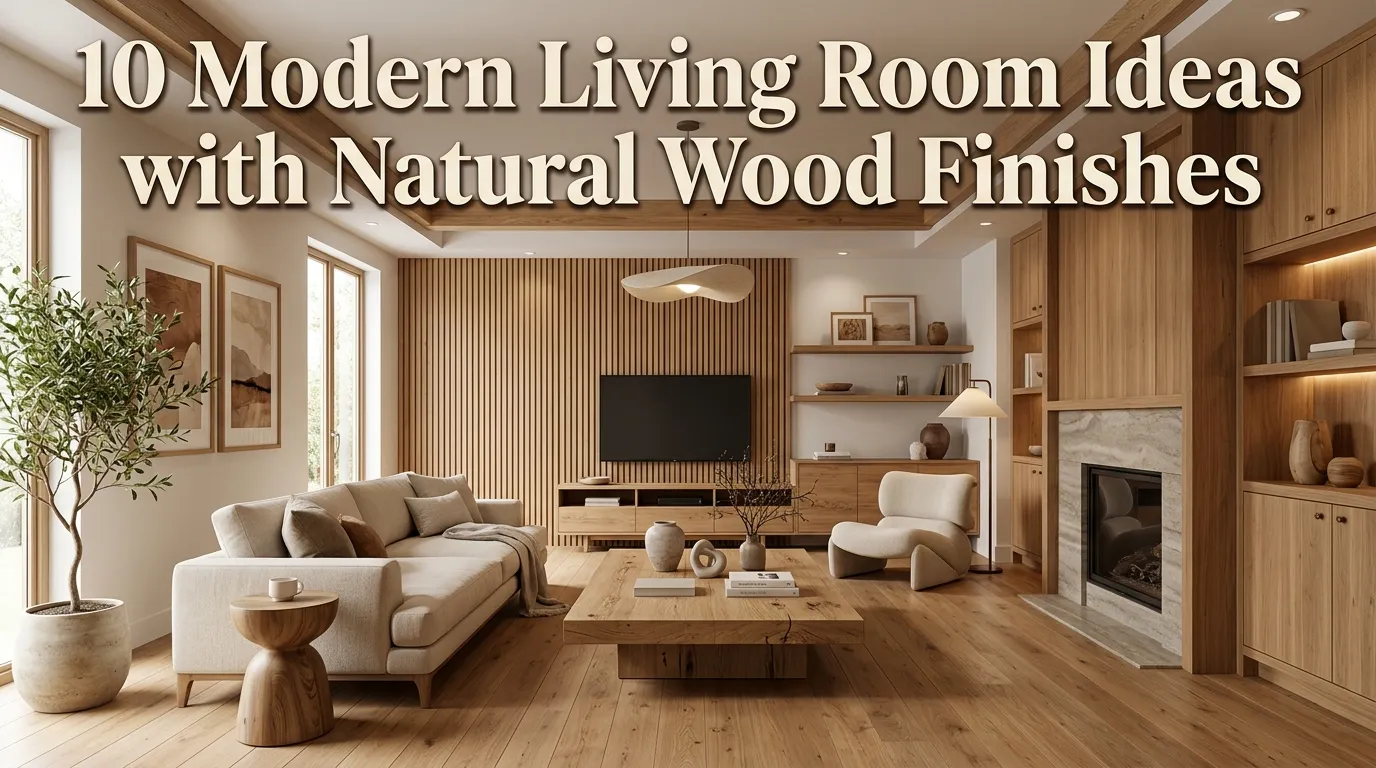
10 Modern Living Room Ideas with Natural Wood Finishes
There’s a particular kind of living room that stops people mid-scroll. It’s not the one with the trendiest paint color or the loudest accent wall — it’s the one that feels warm, grounded, and quietly expensive, even when the budget behind it was modest. In my experience, that feeling almost always comes down to one thing: wood. Real, natural, visible wood — not the gray-washed, over-processed version we saw everywhere a few years ago, but warm, honest wood grain that’s allowed to look like a tree once grew it.
A mistake many homeowners make is treating wood tones like an afterthought, something to match rather than something to design around. They’ll pick a sofa, a rug, and a paint color, and only then wonder why the floor doesn’t quite work with the coffee table, or why the whole room feels flat under bright, cool lighting. Natural wood finishes aren’t just a material choice — they’re a mood. They soften hard architectural lines, add texture in a room that might otherwise rely entirely on fabric and paint, and they age beautifully instead of going out of style the way trend-driven finishes tend to do.
I’ve noticed that the living rooms getting saved the most on Pinterest right now share a common thread: they mix modern silhouettes — clean-lined sofas, matte black hardware, simple geometric shelving — with wood that still shows its grain, its knots, and its natural variation. That contrast is what makes a space feel current instead of dated. It’s warm minimalism, not sterile minimalism.
This guide walks through ten ways to bring natural wood finishes into a modern living room, from flooring and ceilings down to the small furniture details that tie a whole room together. Each idea includes practical styling guidance you can actually use, whether you’re planning a full renovation or just want to swap a few key pieces. If you’re anything like me, you don’t want vague inspiration — you want to know what to buy, what to pair it with, and why it works. That’s exactly what you’ll find below.
Table of Contents
- Warm Oak Flooring — Why a warm-toned oak floor anchors an entire modern room.
- Reclaimed Wood Beams — Adding architectural character overhead without a full renovation.
- Walnut Accent Furniture — Using one striking piece to elevate the whole space.
- Wood Slat Walls — A textured, designer-favorite feature wall you can DIY.
- Natural Wood Coffee Tables — The single easiest upgrade for instant warmth.
- Live Edge Shelving — Turning storage into a sculptural focal point.
- Wood Paneled Ceilings — Bringing the fifth wall into your design plan.
- Textured Wood Trim — Small millwork details that read as high-end.
- Mixed Wood Tones — Why matching every wood exactly is holding your room back.
- Wood and Black Metal — The contrast pairing that defines modern-organic style.
1. Warm Oak Flooring
Quick Benefits
- Instantly warms up cool or neutral color schemes
- Works with nearly every design style, from Scandinavian to transitional
- Hides everyday wear better than pale, cold-toned floors
- Adds resale value as a timeless, non-trend-dependent upgrade
- Pairs easily with rugs, furniture, and changing decor over time
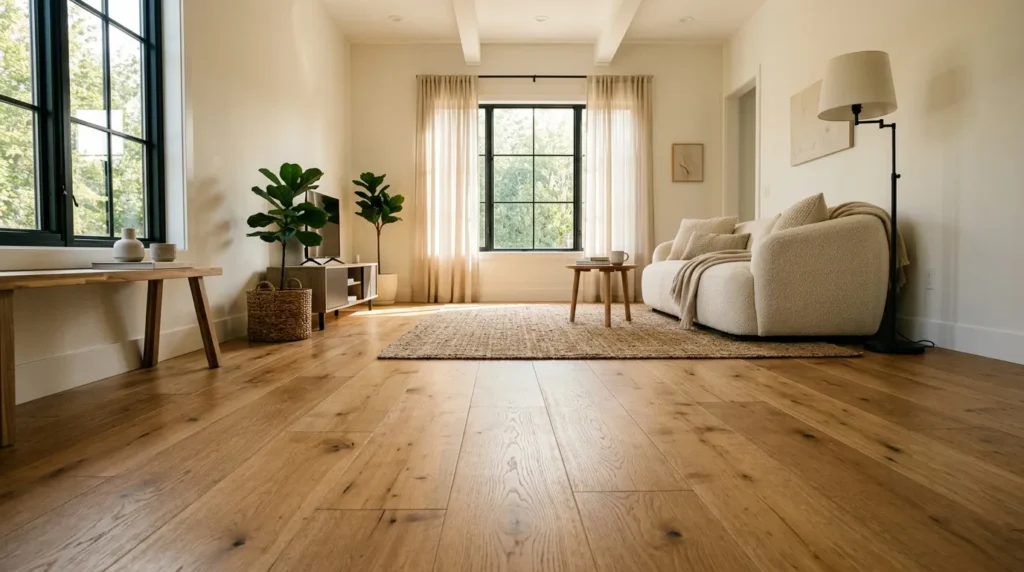
Why It Works Flooring sets the emotional temperature of a room before anything else does. In my experience, homeowners spend months agonizing over paint colors and completely underestimate how much the floor is doing behind the scenes. A warm oak floor — think honey, amber, or soft caramel tones rather than gray or ash — reflects light differently than cool-toned wood or LVP. It bounces warm light back into the room, which makes even north-facing spaces feel sunnier. This is why many designers recommend starting a renovation with flooring, not paint. Everything else, from wall color to furniture, reads differently once you know the undertone of the floor beneath it.
How To Style It Choose a wide-plank oak in a natural or lightly smoked finish rather than a heavily stained, orange-leaning oak, which can feel dated fast. Pair it with a low-pile neutral or ivory rug to let the grain show through at the edges. Furniture in black metal, white oak, or bouclé upholstery tends to look especially current against warm oak. If you’re renting or not ready for new floors, engineered click-lock oak-look flooring or a large jute-and-wood-tone area rug can mimic the effect convincingly.
2. Reclaimed Wood Beams
Quick Benefits
- Adds architectural interest to flat, builder-grade ceilings
- Introduces texture and history without new furniture
- Works in both rustic and modern-industrial spaces
- Draws the eye upward, making ceilings feel taller
- A one-time install with long-term visual payoff
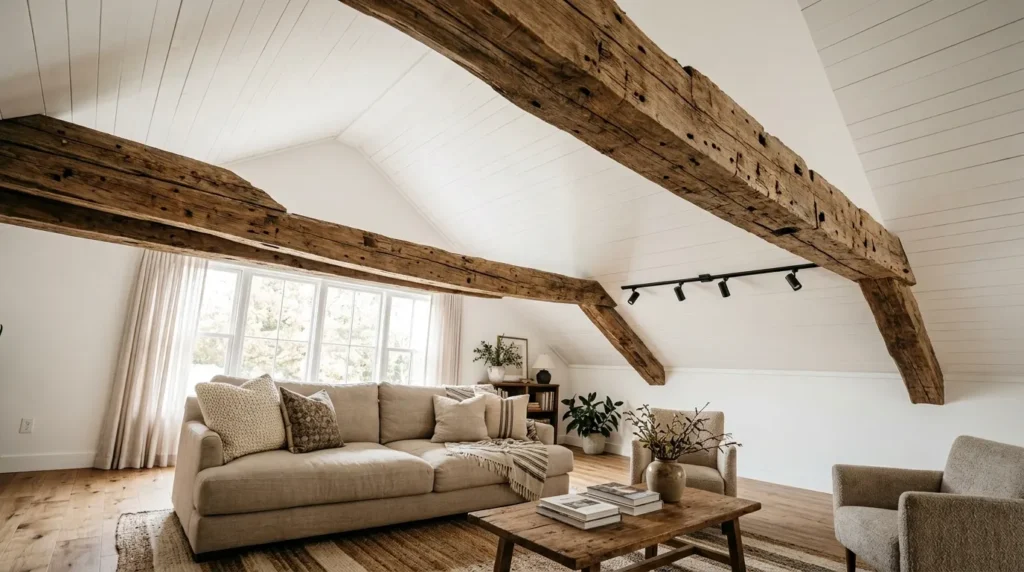
Why It Works One thing that works especially well in a room with plain drywall ceilings is breaking up that blank space with structure. Reclaimed beams — whether structural or decorative faux beams — give a room a sense of history and craftsmanship, even in new-construction homes. I’ve seen this idea transform spaces that felt like generic rentals into rooms that look custom-built. The rough, weathered texture of reclaimed wood also contrasts beautifully with smooth modern surfaces like quartz countertops or matte black lighting, which is exactly the tension that makes a space feel intentional rather than themed.
How To Style It For a modern-organic look, keep beams simple — one or two running the length of the room rather than a full exposed-beam ceiling, which can feel heavy in smaller spaces. Choose a finish with visible saw marks, nail holes, or weathering rather than a uniform stain. Pair with recessed or track lighting so the beams stay the visual focus instead of competing with a large fixture. If a full structural install isn’t realistic, lightweight faux beams made from polyurethane or thin wood veneer achieve a nearly identical look for a fraction of the cost and labor.
3. Walnut Accent Furniture
Quick Benefits
- Adds instant richness and depth to neutral rooms
- Works as a focal point without needing bold color
- Complements both warm and cool undertones in a space
- Elevates a room’s perceived quality more than fabric alone
- Versatile across mid-century, modern, and transitional styles
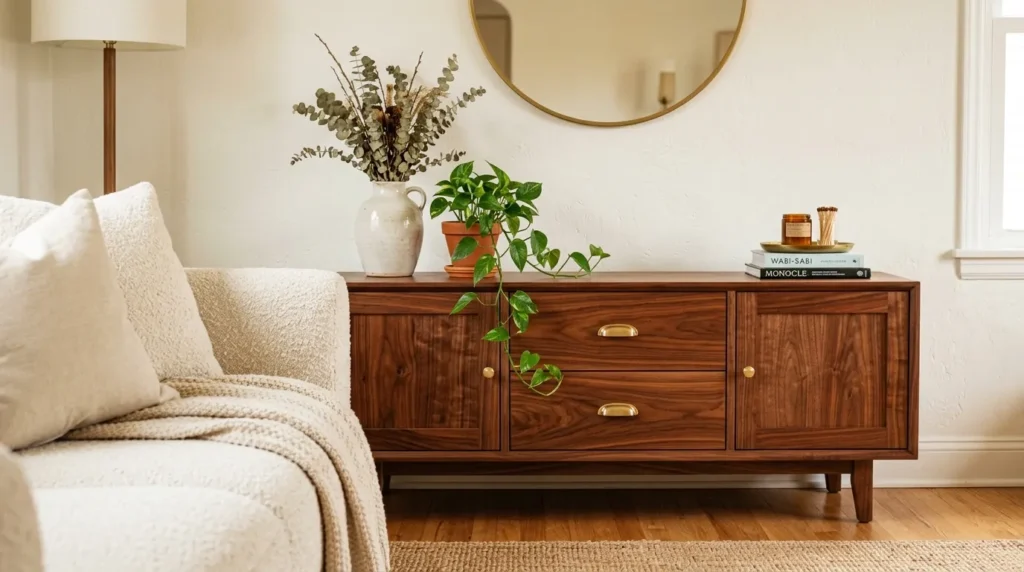
Why It Works Walnut has a deep, reddish-brown tone that reads as inherently upscale, which is why it shows up so often in high-end furniture lines. A mistake many homeowners make is filling a room entirely with lighter woods and wondering why it feels flat. Walnut introduces contrast and depth the way a statement necklace finishes an outfit — it doesn’t need to be everywhere, just present. Because walnut has a naturally darker, richer grain, a single well-placed piece does more visual work than several smaller lighter-wood items combined.
How To Style It A walnut media console, a sculptural side table, or a set of dining chairs pulled into the living room as accent seating are all easy entry points. Keep the surrounding palette neutral — cream, warm white, soft greige — so the walnut piece can stand out rather than blend in. Brass or aged brass hardware pairs beautifully with walnut’s warm undertones, while black metal legs create a more graphic, modern contrast. Avoid mixing walnut with orange-toned oak in the same sightline; the undertones tend to clash unless a rug or neutral surface separates them.
4. Wood Slat Walls
Quick Benefits
- Creates a designer-level feature wall on a manageable budget
- Adds acoustic softness and texture to plain rooms
- Works behind sofas, TVs, or as an entryway statement
- A popular, highly-saveable Pinterest and DIY project
- Customizable in wood tone, spacing, and slat width
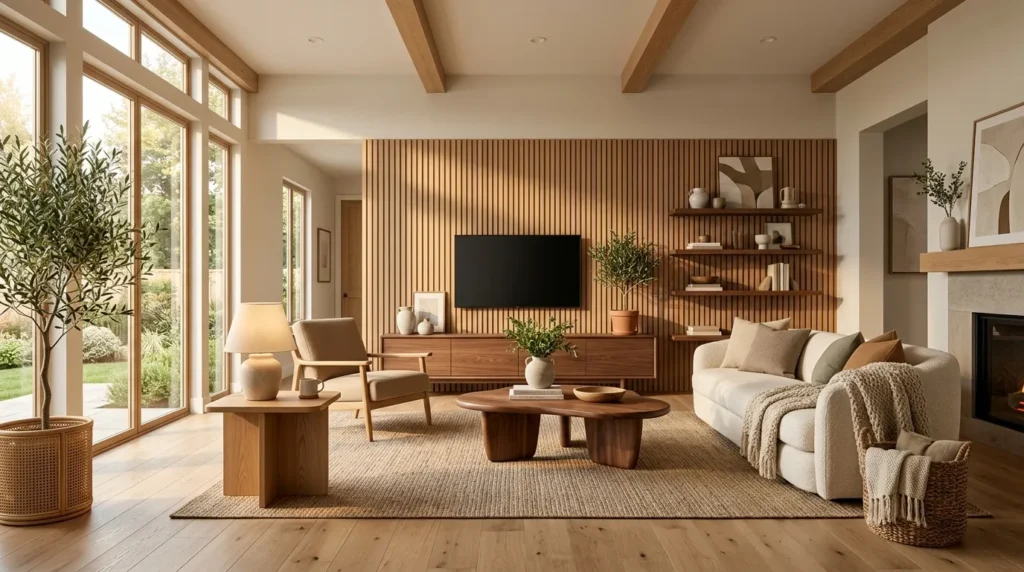
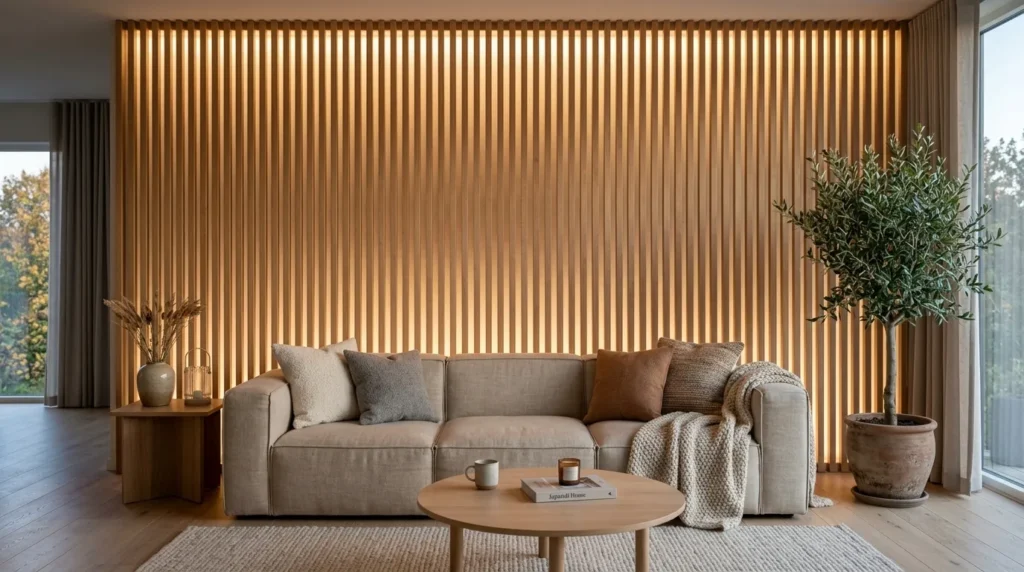
Why It Works Slat walls have become one of the most requested features in modern living rooms, and it’s easy to see why once you understand the effect. The repeated vertical lines add rhythm and texture to an otherwise flat wall, and depending on spacing, they can make ceilings feel taller. In my experience, this is one of the highest-impact, lowest-cost updates a homeowner can make — a slat wall transforms a plain drywall backdrop into what looks like a custom millwork feature, often for a few hundred dollars in materials.
How To Style It Use pine, poplar, or pre-finished slat panels in a light or mid-tone wood for a Scandinavian-modern feel, or a darker walnut-stained slat for a moodier, richer look. Install behind the TV or sofa as a focal wall rather than on every wall in the room. Keep spacing consistent — roughly the width of one slat between each board is a classic, balanced ratio. Pair with simple, unfussy furniture so the wall itself remains the star, and consider integrating LED strip lighting behind the slats for a soft evening glow.
5. Natural Wood Coffee Tables
Quick Benefits
- The easiest single swap for instant natural warmth
- Anchors a seating area without overwhelming the space
- Available at every price point and style
- Adds organic shape to rooms full of straight lines
- Easy to update or replace as style evolves
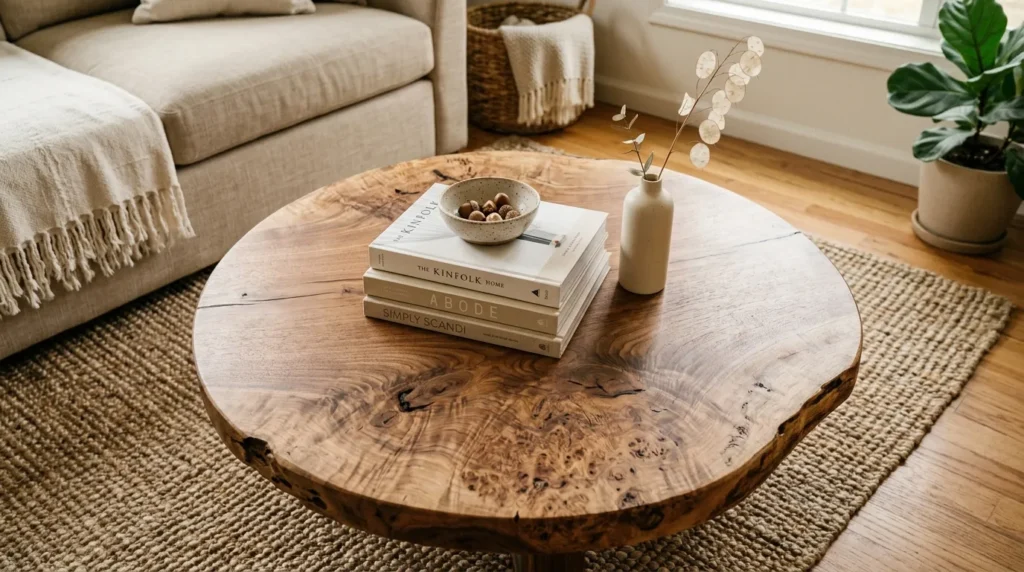
Why It Works If you only make one change from this list, this is the one I’d suggest first. A natural wood coffee table sits at the visual center of most living rooms, which means it has an outsized influence on how “designed” the space feels. Glass and metal coffee tables, while sleek, can leave a room feeling cold or unfinished. Wood introduces organic shape and warmth right where the eye naturally lands, and because it’s a smaller-scale piece, it’s one of the lowest-risk, lowest-cost ways to test whether you like a wood tone before committing to it elsewhere.
How To Style It Round or organically shaped tables soften a room full of straight-edged sofas and rectangular rugs, while rectangular wood tables with tapered legs suit more streamlined, minimalist spaces. Live-edge or burl wood tables add a sculptural, one-of-a-kind quality. Style the surface with a stack of books, a low ceramic bowl, and one small plant or dried floral arrangement — resist the urge to overdecorate a wood surface, since the grain itself is the decoration.
6. Live Edge Shelving
Quick Benefits
- Turns functional storage into a sculptural feature
- Showcases the natural, irregular beauty of the wood grain
- Works well in minimalist rooms that need texture
- A conversation-starting focal point for guests
- Pairs easily with black metal brackets for contrast
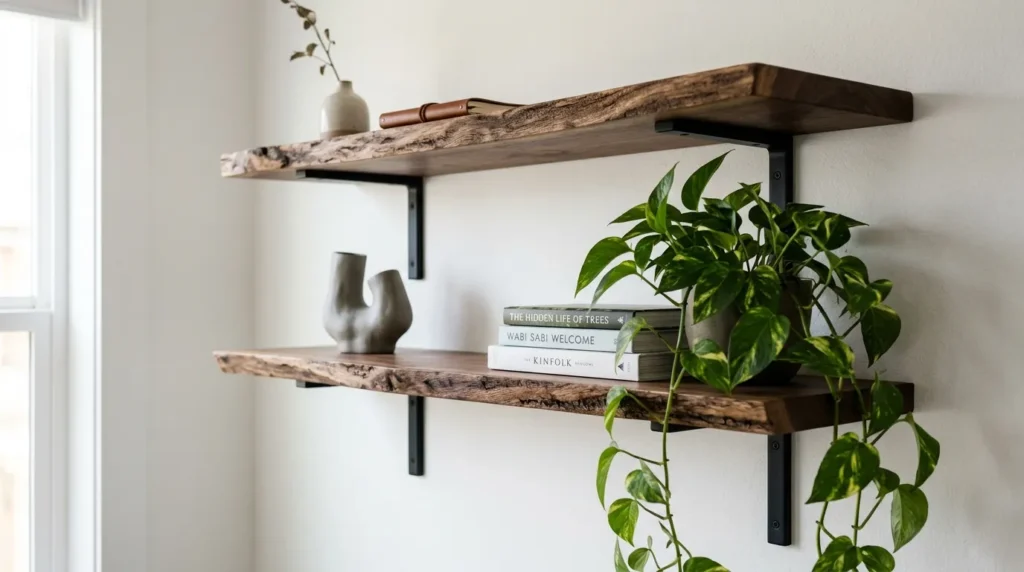
Why It Works Live edge shelving keeps the natural, uneven edge of the tree intact rather than cutting it into a perfect rectangle, and that small detail changes everything about how a shelf reads. Instead of looking like a mass-produced storage unit, it looks like a piece of functional art. That’s why many designers recommend live edge pieces specifically for rooms that are otherwise very clean and minimal — the irregular edge provides organic contrast against straight walls and boxy furniture without adding visual clutter.
How To Style It Choose walnut, maple, or acacia live edge shelves mounted on simple black metal brackets for a graphic, modern-industrial contrast, or hidden floating brackets for a cleaner, more minimalist look. Keep styling sparse: a few books stacked horizontally, one small sculptural object, and a trailing plant is usually enough per shelf. Overloading a live edge shelf hides the very feature that makes it special, so treat it more like a gallery ledge than standard storage.
7. Wood Paneled Ceilings
Quick Benefits
- Uses the “fifth wall” as an active design element
- Adds warmth and coziness to tall or open-concept rooms
- Creates a striking visual moment for photos and Pinterest saves
- Balances out large expanses of white wall or ceiling
- Works in both traditional and thoroughly modern spaces
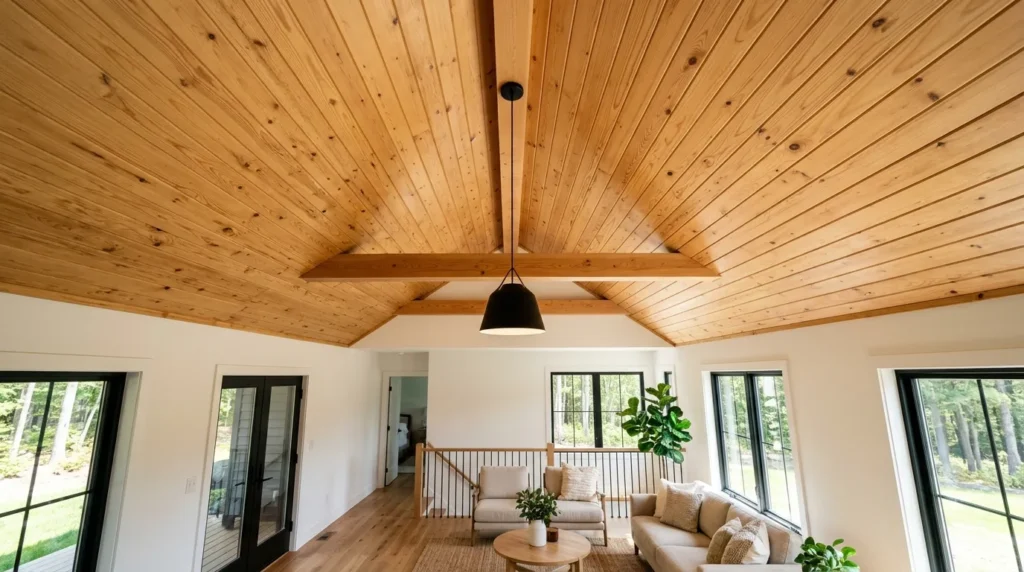
Why It Works Ceilings are the most overlooked surface in most homes, which is exactly why a wood-paneled ceiling makes such a strong impression. In tall or vaulted rooms, a plain white ceiling can feel cavernous and cold. Wood paneling brings the scale back down to a human level and adds warmth exactly where a room often needs it most. I’ve noticed that this idea performs especially well in open-concept living rooms, where a wood ceiling helps visually define the living area as its own distinct zone within a larger open floor plan.
How To Style It Tongue-and-groove pine or cedar paneling in a natural or lightly whitewashed finish keeps the look bright and modern rather than heavy or cabin-like. For a bolder statement, a rich walnut-stained ceiling paired with brass or matte black lighting creates a dramatic, editorial-style room. Keep the rest of the ceiling elements simple — one clean light fixture rather than several competing pieces — so the wood itself remains the focal point rather than getting visually crowded.
8. Textured Wood Trim
Quick Benefits
- Adds high-end, custom millwork character
- Works on a single wall or throughout the room
- Bridges traditional architecture with modern furniture
- A relatively affordable way to add visual texture
- Increases perceived home value
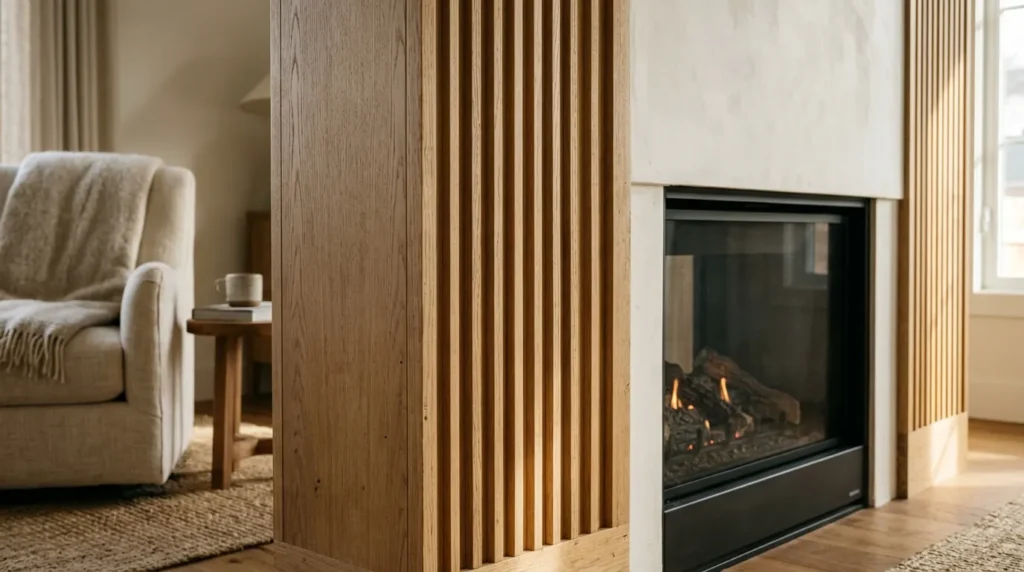
Why It Works Fluted, reeded, or slatted wood trim has become a signature of modern-organic interiors because it adds dimension without adding color or pattern. A mistake many homeowners make is assuming trim work is either purely traditional (crown molding, wainscoting) or purely modern (flat, minimal baseboards) — but textured wood trim sits in between, offering craftsmanship and detail while still feeling current. It photographs beautifully because the vertical grooves catch and shift light throughout the day, giving an otherwise static wall a subtle sense of movement.
How To Style It Consider fluted wood panel inserts around a fireplace, TV wall, or the lower half of a room as a modern take on wainscoting. Keep the wood tone consistent with at least one other wood element in the room — the coffee table or shelving, for example — so the trim doesn’t read as disconnected. Paint-grade fluted panels are a budget-friendly alternative if you want the textured look without committing to a natural wood finish, though pairing at least a few real wood elements nearby keeps the room from feeling one-note.
9. Mixed Wood Tones
Quick Benefits
- Frees you from matching every wood item exactly
- Creates a collected, layered, non-showroom feel
- Adds depth and visual interest through variation
- Makes a room feel like it evolved naturally over time
- Easier to shop for since nothing has to match perfectly
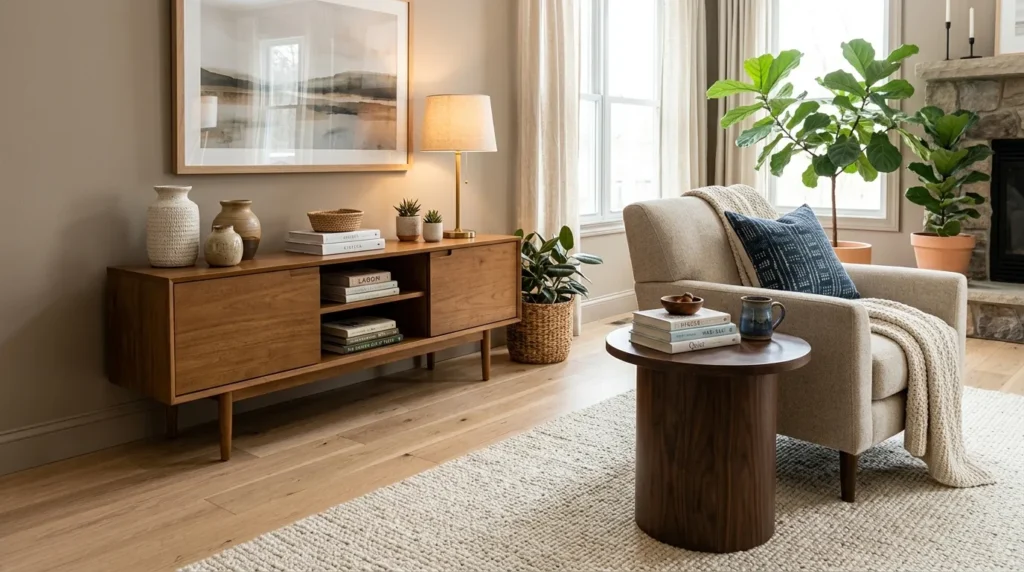
Why It Works This is the rule that trips up more homeowners than any other on this list: you do not need every wood surface in your living room to match. In my experience, rooms where every piece of wood is the exact same tone often end up looking more like a furniture showroom than a lived-in home. Real, well-designed spaces mix wood tones the same way they mix metals or textures — intentionally, with a shared undertone (warm or cool) even when the exact shade varies. This is what gives a room that “collected over time” feeling that’s genuinely hard to fake.
How To Style It Pick one dominant wood tone — your floor, most likely — and treat every other wood piece as either a close match or a deliberate contrast, avoiding anything in between that reads as an “almost match” mistake. A general rule: two to three different wood tones in a room feels intentional; four or more starts to feel chaotic. Use a neutral rug, wall color, or large upholstered piece as a visual buffer between the most contrasting wood tones, such as a light oak floor and a dark walnut console.
10. Wood and Black Metal
Quick Benefits
- Defines the modern-organic aesthetic in one simple pairing
- Adds graphic contrast without introducing new colors
- Works across lighting, hardware, shelving, and furniture legs
- Keeps a wood-heavy room from feeling too soft or rustic
- Easy to shop for at nearly any price point
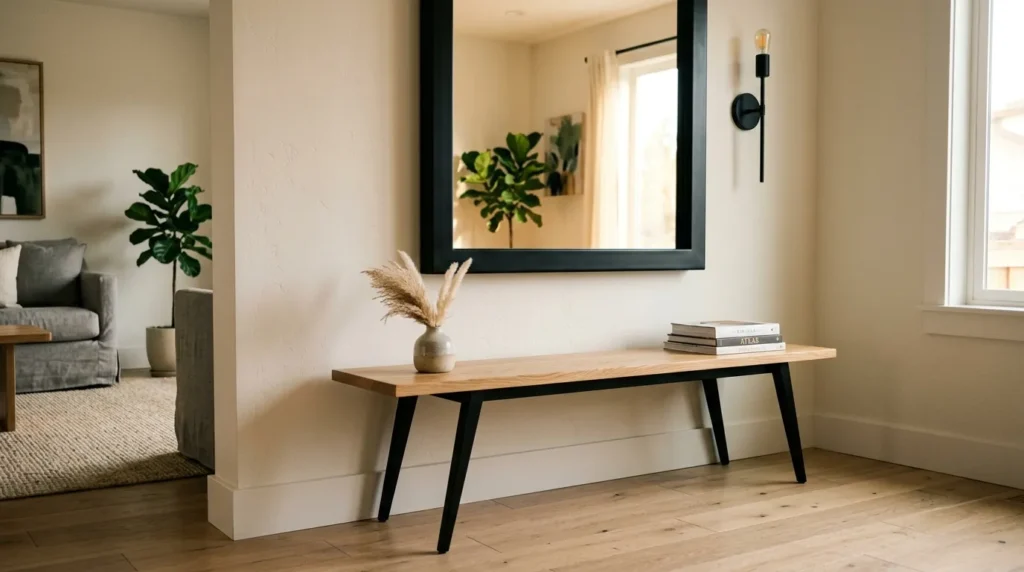
Why It Works If there’s one pairing responsible for the modern farmhouse-meets-minimalist look that’s dominated Pinterest for the past several years, it’s this one. Black metal grounds natural wood’s warmth with something sharp, graphic, and unmistakably current. Without it, a wood-heavy room risks tipping into overly rustic or cabin-like territory. One simple trick I always suggest is looking at a finished room and asking whether it needs one black element — a light fixture, a shelf bracket, a table leg — to keep the warmth from feeling soft or dated.
How To Style It Matte black pendant lighting over a wood coffee table, black hairpin or angled legs on a wood bench, or black metal shelf brackets against a light wood wall are all easy, budget-friendly ways to bring in this pairing. Keep the black metal to accents and structural elements rather than large upholstered pieces, which can start to feel heavy. A single black-framed mirror or piece of art above a wood console is often all a room needs to complete the look.
Frequently Asked Questions
Does natural wood make a small living room feel smaller? Not if the tone is chosen carefully. Light to mid-tone woods like white oak or ash tend to open a small room up, while very dark woods like espresso or ebony can feel heavier in tight spaces. Balancing wood with plenty of white or neutral wall space keeps a small room feeling airy rather than closed in.
Can I mix wood tones without it looking mismatched? Yes, and in most cases mixing tones looks more designed than matching everything exactly. The key is sticking to a consistent undertone — warm woods together, cool woods together — and limiting yourself to two or three distinct tones in one room.
What’s the most budget-friendly way to add natural wood to a living room? A wood coffee table or a small slat-wall accent are usually the most affordable, highest-impact starting points. Both can be added without touching flooring, ceilings, or built-ins, making them ideal for renters or smaller budgets.
Is wood paneling hard to maintain? Sealed and finished wood paneling is generally low-maintenance, needing only occasional dusting and an avoidance of excess moisture. In humid climates, a matte polyurethane or sealant finish helps protect the wood from warping over time.
What wood tone works best with a neutral, greige-toned living room? Warm mid-tone woods like white oak, ash, or light walnut tend to complement greige palettes especially well, since both share soft, warm-neutral undertones without competing with each other.
Do I need to match my furniture wood to my flooring exactly? No — in fact, an exact match can sometimes look flat. A close match with a few intentional contrast pieces, like a darker walnut side table against a lighter oak floor, tends to create more visual depth.
Is natural wood a passing trend? Natural wood finishes have been a consistent design staple for decades, moving through cycles of popularity rather than disappearing. Because wood is a material rather than a specific color trend, it tends to age far better than painted or laminate alternatives.
Final Thoughts
Bringing natural wood finishes into a modern living room isn’t about overhauling everything at once — it’s about choosing a few intentional touchpoints and letting the material do what it does best: add warmth, texture, and a sense of quality that’s hard to fake with paint or fabric alone. Whether that starts with a single wood coffee table, a slat-wall accent, or a full flooring update, each idea on this list works on its own or layered together as your space and budget allow.
Start with one or two ideas and gradually build a space that reflects your style and supports everyday comfort. The goal isn’t a showroom-perfect room — it’s a living room that feels warm, current, and genuinely yours.
Related Articles
- Cozy Neutral Bedroom Ideas for a Calming Retreat
- Small Living Room Layouts That Actually Work
- Modern Farmhouse Decor Ideas for Every Room
- Neutral Home Styling on a Budget
- DIY Accent Wall Ideas Anyone Can Do